When your home or business takes on water, the first call you make might be to your insurance company. But before you dial, there’s a critical question that will shape everything about your claim: Was this water damage or flood damage?
Most homeowners assume these two terms mean the same thing. They don’t – and that misunderstanding costs property owners thousands of dollars every year in denied or underpaid claims. Whether you’re in Mesa, AZ dealing with a monsoon aftermath or in Little Rock, AR recovering from a river overflow, knowing the difference before disaster strikes could be the most valuable thing you read this year.
What Is Water Damage – and How Does Insurance Define It?
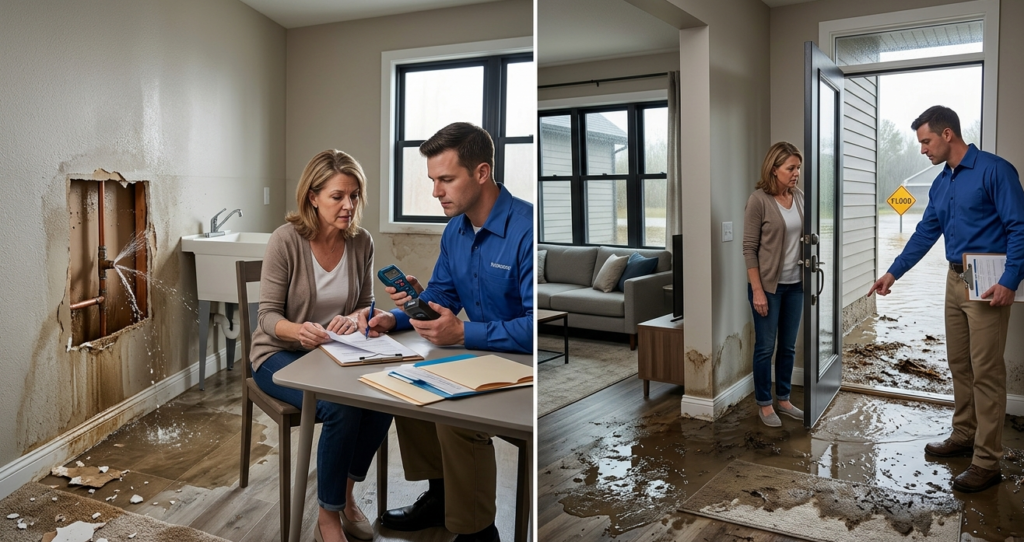
In the world of insurance, water damage refers to water that originates from inside your home or comes from above. It is sudden, accidental, and internal. Standard homeowners insurance policies (HO-3 policies) typically cover this type of damage.
Common examples that most standard policies cover include:
- A burst pipe in your wall or ceiling
- A washing machine hose that fails and soaks your laundry room floor
- A dishwasher overflow that damages your kitchen cabinets and subfloor
- An air conditioning unit drain line that backs up and leaks into your ceiling
- A roof leak caused by a covered storm event that allows water to enter
The key phrase insurance adjusters look for is “sudden and accidental.” If water entered your home unexpectedly from an internal source and you couldn’t reasonably have prevented it, your standard homeowners policy likely has you covered.
However, there are important exceptions. Most standard policies do not cover:
- Gradual leaks or slow seepage you knew about but didn’t fix
- Damage from long-term neglect or deferred maintenance
- Sewage backups (unless you have a separate sewer backup endorsement)
- Water that enters through the foundation or seeps up through the ground
For help navigating water damage insurance claims in Mesa, having a local restoration company document the damage thoroughly from the moment they arrive makes all the difference in how smoothly your claim processes.
What Is Flood Damage – and Why Is It Treated Differently?
Flood damage is water that comes from an external, natural source – water that rises from the ground up rather than falling or flowing from above. The insurance industry defines a flood very specifically: it involves surface water that inundates normally dry land, typically affecting two or more properties or at least two acres of land.
Common examples of flood damage include:
- A river, creek, or drainage channel overflowing its banks and entering your home
- Rapid accumulation of rainwater on the ground that flows into your basement or first floor
- Storm surge from a hurricane or tropical weather event
- Overflow from a nearby lake or reservoir
- Flash flooding on streets that directs surface water into structures
Here is the critical point that catches most homeowners off guard: standard homeowners insurance policies do not cover flood damage. They never have. Flood coverage requires a completely separate policy, most commonly through the National Flood Insurance Program (NFIP), administered by FEMA. Private flood insurance is also available through some carriers, though it is less common.
In Mesa, Arizona, many homeowners assume they don’t need flood coverage because the desert climate feels dry most of the year. But Mesa’s monsoon season – running roughly from June through September – brings intense, fast-moving storms that can overwhelm drainage systems and create flash flood conditions extremely quickly. The Salt River and various canals running through the East Valley create genuine flood risk zones that many property owners overlook until it’s too late.
In Little Rock, Arkansas, proximity to the Arkansas River and its tributaries means flood risk is a very real concern for neighborhoods from Riverfront to the Heights. Little Rock water damage professionals respond regularly to situations where homeowners assumed their standard policy covered river-related flooding – only to discover their claim was denied.
The Gray Zone: When It’s Hard to Tell
One of the most common disputes between homeowners and insurance adjusters involves situations where both types of damage occur simultaneously — or where the origin of water is genuinely unclear.
Scenario 1: Storm damage + internal leak A severe thunderstorm hits. Wind-driven rain gets under your roof flashing, and at the same time, runoff overwhelms your drainage system and backs up into your basement. You now have a covered roof leak (water damage) and a potential flood or sewer backup issue (likely not covered under standard policy) happening at the same time. Two separate claims, two different coverage determinations.
Scenario 2: Burst pipe during a flood event Your area experiences flash flooding. While dealing with external water, a pipe inside your home bursts from pressure. The burst pipe itself may be a covered water damage event, but the external flooding is not. Untangling these requires careful documentation of each damage source.
Scenario 3: Sump pump failure Your sump pump fails during a heavy rainstorm and your basement fills with water. Whether this is covered depends heavily on your specific policy. Some policies cover sump pump failure as water damage. Others exclude it. Many insurers offer a separate sump pump or water backup endorsement for around $50–150 per year that covers exactly this scenario.
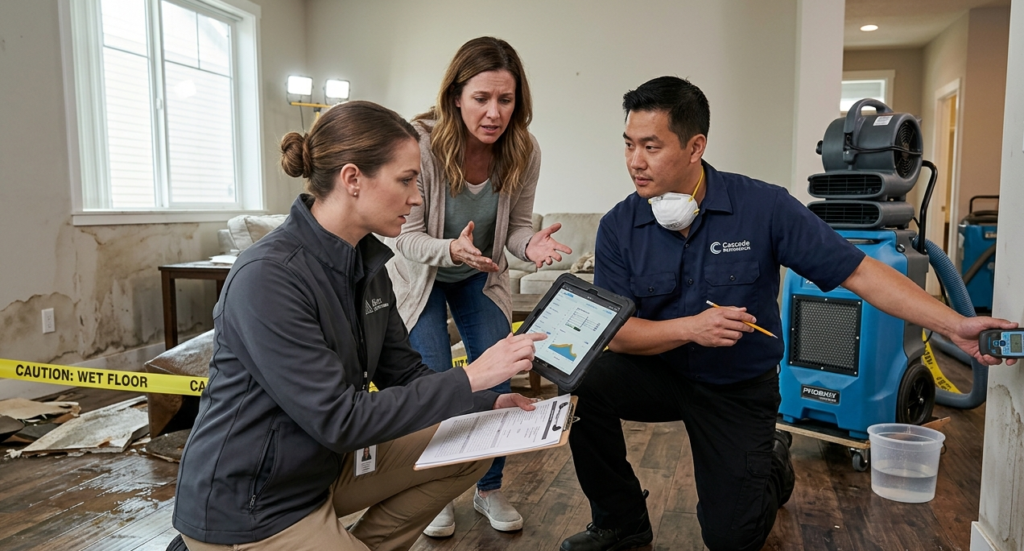
This is why professional moisture detection and damage assessment matters so much during the documentation phase. A trained restoration technician can help identify the origin and pathway of water intrusion, which directly supports your insurance claim narrative.
How to File the Right Claim: A Practical Guide
Whether you are dealing with water damage, flood damage, or both, the steps you take in the first 24–48 hours determine the strength of your claim.
Step 1 – Stop the source immediately. Shut off your main water supply if the damage is from a burst pipe or internal failure. If flooding is from an external source, focus on moving valuables to higher ground and staying safe.
Step 2 – Document everything before cleanup begins. Take photos and video of every affected room, surface, and item. Capture the water source if visible. This documentation is the foundation of your claim and must be done before anything is moved, dried, or discarded.
Step 3 – Call your insurance company and identify the damage type. When you call, describe the source of water as specifically as possible. Use language that matches your coverage: “a pipe burst inside my wall” for water damage versus “the creek behind my property overflowed” for potential flood damage. The initial report sets the tone for the entire claim.
Step 4 – Call a professional restoration company immediately. Do not wait for adjuster approval before beginning mitigation. Most policies require you to take reasonable steps to prevent further damage. A restoration team can begin emergency water extraction immediately while providing the documentation your adjuster needs. In Little Rock, emergency water extraction services are available 24/7 with crews on-site within 60 minutes.
Step 5 — Request an itemized scope of work from your restoration company. A professional scope of work with photos, moisture readings, and material lists is far more effective with an adjuster than a handwritten estimate. Reputable restoration companies work directly with insurance carriers and understand exactly what documentation is required.
Does Your Policy Actually Cover What You Think It Does?
Most homeowners have never read their full insurance policy. The honest truth is that the exclusions section – not the coverage section – is where most claims run into trouble.
According to FEMA, nearly 20 percent of flood insurance claims come from properties outside high-risk flood zones. This means even if your neighborhood doesn’t feel flood-prone, the risk may be higher than you realize.
A few things worth checking on your current homeowners policy:
Water backup endorsement – Covers damage from sewage or drain backups. Usually inexpensive to add and worth every dollar if you have a basement. This is separate from standard water damage coverage.
Flood insurance – If you don’t already have a separate flood policy through the NFIP or a private carrier, call your agent and ask about your flood risk zone. In both Mesa and Little Rock, properties near drainage channels, rivers, or low-lying areas carry real flood exposure.
Mold coverage – Some policies limit mold remediation coverage or exclude it after a certain time. This is why rapid response matters: mold can begin growing within 24–48 hours of water exposure, and delay can turn a covered water damage claim into an uncovered mold remediation project.
Actual cash value vs. replacement cost value — Know which your policy provides. Actual cash value subtracts depreciation from the payout, meaning older flooring or drywall is reimbursed at a fraction of what it costs to replace today.
What Happens When a Claim Is Denied
If your claim is denied, it does not mean the conversation is over. Common reasons for denial include:
- The adjuster determines the damage was from flooding rather than a covered internal source
- The damage is attributed to neglect or maintenance failure rather than a sudden event
- Insufficient documentation of the damage origin
- Policy exclusions for the specific type of water intrusion
In many cases, a denial can be challenged with better documentation. A detailed restoration report from an IICRC-certified technician showing the moisture pathway, origin point, and timeline of damage is often the most effective tool in an appeal. Both Water Damage Restoration Mesa and Little Rock AR Water Damage work directly with insurance carriers and can assist in providing documentation to support your claim.
If you believe a denial was improper, you also have the option of filing a complaint with your state’s department of insurance. In Arkansas, the Arkansas Insurance Department provides a formal consumer complaint process for disputed claims.
The Bottom Line: Know Before Disaster Strikes
The difference between water damage and flood damage is not just terminology – it’s the difference between a covered claim and a five-figure out-of-pocket expense.
Here’s the quick reference:
| Water Damage | Flood Damage | |
|---|---|---|
| Source | Internal (pipe, appliance, roof leak) | External (river, rainfall, storm surge) |
| Covered by standard homeowners policy? | Usually yes | No – requires separate flood policy |
| FEMA/NFIP involvement? | No | Yes |
| Sewer backup covered? | Only with endorsement | No |
| Documentation needed | Photos, moisture readings, restoration scope | Same, plus proof of flood event |
If you are in Mesa, AZ and dealing with water or flood damage right now, call Water Damage Restoration Mesa at (480) 806-2607 – available 24/7 for emergency response across all East Valley communities.
If you are in Little Rock, AR, call Little Rock AR Water Damage at (501) 232-9682 – on-site anywhere in Little Rock and Pulaski County within 60 minutes, day or night.
Do not wait. Every hour water sits in your property, the damage deepens, the costs climb, and the window for a clean insurance claim narrows.
This article is for general informational purposes. Insurance coverage varies by policy and carrier. Always review your specific policy terms or consult a licensed insurance professional for guidance on your coverage.
Leave a Reply