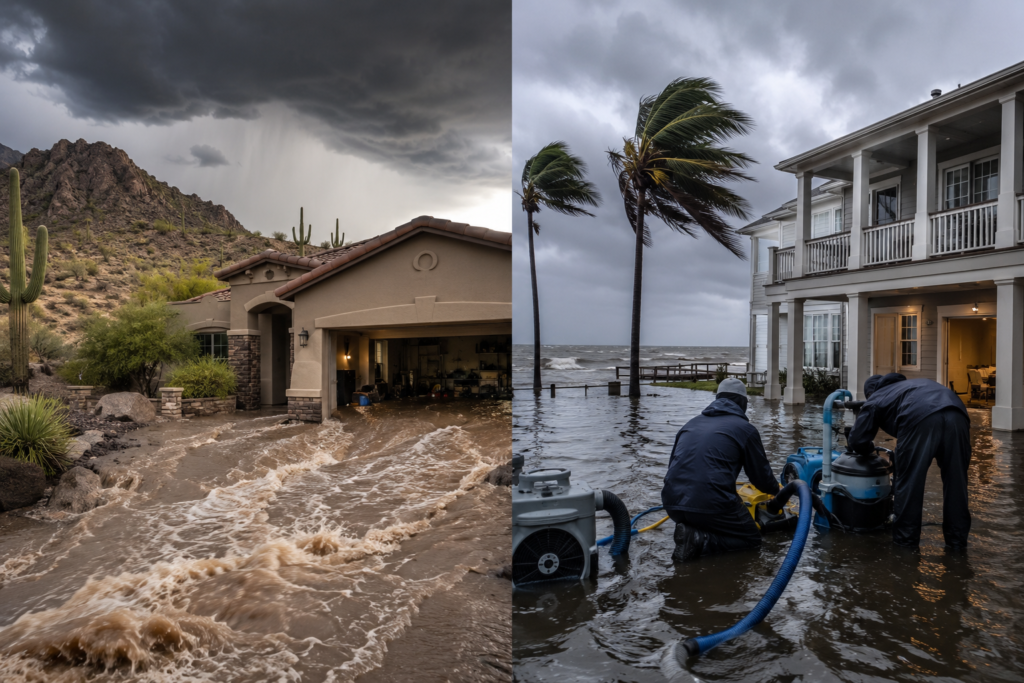
Water damage doesn’t look the same everywhere. A homeowner in Mesa, Arizona and a homeowner on the Gulf Coast in Mobile, Alabama can both end up calling a restoration company in the same week – but they’re dealing with almost opposite problems. One is fighting a flash flood that formed in twenty minutes over bone-dry ground. The other is fighting a hurricane that’s been tracked for days and brings sustained, saturating rain and storm surge. Understanding that difference matters, because it changes what you should watch for and how restoration teams respond in each region.
Mesa’s Risk: Fast, Violent, and Over Almost as Quickly as It Starts
Arizona’s flood risk comes from the North American Monsoon, which typically reaches the desert Southwest in early July and continues through September. The mechanism is almost the opposite of a hurricane: intense heat causes air to rise rapidly off the desert floor, pulling in moisture that builds into short, powerful thunderstorms.
What makes this dangerous isn’t total rainfall – it’s speed and terrain. NWS Flagstaff describes flash floods in Arizona as “more water than you want in less time than you have,” and notes that the area’s arid, sparsely vegetated ground has very little capacity to absorb rainfall, so runoff moves rapidly through narrow canyons and steep terrain, turning dry washes into fast-moving torrents within minutes. Arizona averages around 4 flood fatalities a year, and storms can strike with little warning – a clear, sunny day in one part of the Valley can turn into a flash flood downstream from a storm that happened miles away.
For Mesa homeowners, this means the restoration problem usually starts with rapid water intrusion through low points – patios, garages, window wells, and ground-level entry points – rather than prolonged saturation. Once water gets in, the desert’s low ambient humidity actually works in a homeowner’s favor for drying speed, but structural drying and moisture detection are still critical, since trapped moisture behind drywall or under flooring won’t evaporate on its own even in a dry climate.
Mobile’s Risk: Slow Building, Long Duration, Saltwater Involved
The Gulf Coast faces an entirely different threat profile. Storm surge and inland flooding from hurricane rainfall have historically been among the leading causes of hurricane-related deaths, and surge can push several miles inland along bays and rivers – not just hit the immediate beachfront. Unlike a monsoon storm, a hurricane is tracked for days before landfall, but the water damage it causes tends to last far longer once it arrives.
That’s because Gulf Coast flooding often involves two separate problems stacked on top of each other: storm surge pushing saltwater inland, and sustained rainfall saturating the ground for days afterward. Saltwater intrusion behaves differently than fresh water – it accelerates corrosion in electrical systems and HVAC components and leaves behind a salt residue that can re-attract moisture long after a property looks dry. If you’re in the Mobile, Alabama area specifically, Mobile AL Water Damage has a more detailed local breakdown of what hurricane prep and storm surge exposure looks like for Gulf Coast homeowners.
Same Outcome, Different Path to Get There
Despite the very different causes, both regions converge on the same urgent fact once water gets into a home: the first 24-48 hours determine whether damage is repairable or becomes a full rebuild. In Mesa, that often means fast flood damage assessment and extraction before flash floodwater has a chance to seep into flooring and drywall. On the Gulf Coast, it more often means dealing with basement flood recovery and extended drying timelines, since saturated ground and saltwater contamination keep causing damage well after the storm itself has passed.
Storm damage in either climate also tends to come with secondary water intrusion through roofs and window seals – which is why storm damage mitigation is part of the response in both regions, not just the obvious flooding itself.
What This Means If You’re Watching the Forecast
If you live in a flash-flood-prone area like Mesa, the lesson is to act on warnings immediately – flash floods give you minutes, not days, and low-lying entry points to your home are the first thing to check. If you’re in a hurricane-prone area like Mobile, the lesson is closer to the opposite: you have days of warning, so use that time to prepare for a longer event, including reviewing whether your insurance actually covers flood damage, since standard homeowners policies typically exclude it. You can check flood risk and coverage options through FEMA’s flood insurance program regardless of which climate you’re in.
The Bottom Line
A flash flood and a hurricane can both leave you with a flooded home, but they get there in almost opposite ways – one in minutes, the other over days, one fresh water, the other often saltwater. Knowing which risk applies to your region is the first step in actually preparing for it, and it’s why restoration teams in Mesa and on the Gulf Coast approach water damage differently even though the end goal – getting your home dry and safe again – is exactly the same.
Leave a Reply