Water damage is one of the most stressful and destructive events a homeowner can face. Whether it’s caused by a burst pipe, a flash flood, a leaking roof, or an overflowing appliance, standing water inside your home can cause serious structural damage, destroy personal belongings, and create the perfect environment for mold growth – all within a matter of hours. That is why professional water extraction and drying is not just a recommendation; it is an absolute necessity.
Top restoration professionals across the United States follow proven, science-backed techniques to remove water quickly and restore properties to their pre-damage condition. In this blog post, we break down exactly what those techniques are, why they work, and what you should expect when you call a certified restoration team.
Why Speed Is Everything in Water Damage Restoration
The first 24 to 48 hours after water damage occurs are the most critical. Within minutes, water begins to spread into walls, flooring, and furniture. Within hours, drywall starts to swell and break down. Within 24 to 48 hours, mold can begin to take hold — and once mold establishes itself, remediation becomes significantly more expensive and time-consuming.
This is why professional water damage restoration services are built around rapid response. Certified technicians are trained to arrive quickly, assess the damage, and begin extraction immediately – every hour counts.
Step 1: Water Damage Assessment and Moisture Mapping
Before any equipment is deployed, restoration pros conduct a thorough assessment of the affected area. This involves:
- Moisture meters to detect water content in walls, floors, and ceilings
- Infrared (thermal) cameras to identify hidden moisture pockets behind surfaces
- Hygrometers to measure ambient humidity levels in the air
This moisture mapping process is essential because water rarely stays where it first lands. It travels through porous materials, seeping into subfloors, wall cavities, and insulation – areas that are invisible to the naked eye. Without proper mapping, drying efforts can miss critical zones, leading to hidden mold growth weeks later.
Step 2: Professional Water Extraction
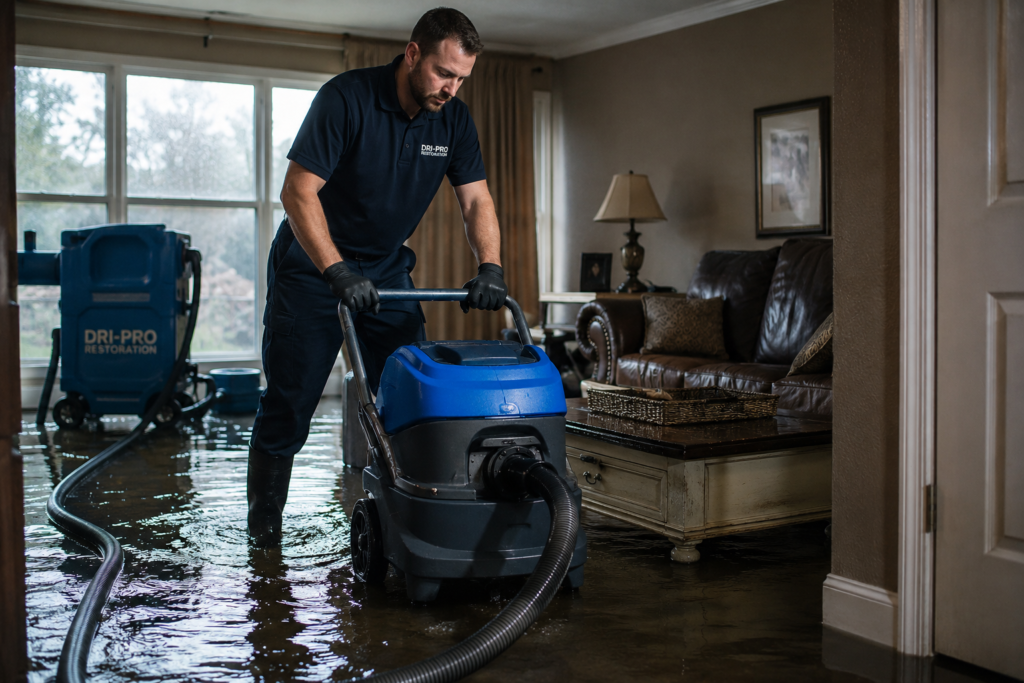
Once the scope of damage is understood, the extraction phase begins. This is the most time-sensitive step and requires industrial-grade equipment that far exceeds what you can rent at a hardware store.
Truck-mounted extraction units are among the most powerful tools in a restoration pro’s arsenal. These units can remove hundreds of gallons of water per hour and are especially effective for large-scale flooding. For tighter spaces or interior rooms far from a vehicle, portable extraction units offer flexibility without sacrificing suction power.
Submersible pumps are used when standing water is several inches or more deep – common in flooded basements and crawl spaces. Once the bulk of the water is removed, technicians switch to wet/dry vacuums and specialty wands to pull residual moisture from carpet padding, hardwood seams, and tile grout.
Our water damage repair services in Mesa, AZ utilize all of these extraction methods depending on the severity and location of the damage – ensuring no water is left behind to cause further harm.
Step 3: Structural Drying with Industrial Air Movers
Extraction removes standing and surface water, but moisture still remains trapped inside building materials. This is where the drying phase begins – and it is far more complex than simply opening windows or running a household fan.
Industrial air movers (also called axial fans or centrifugal blowers) are strategically placed to create a high-velocity airflow across wet surfaces. This accelerates evaporation by pulling moisture out of materials and suspending it in the air. A typical water-damaged room may require several air movers positioned at precise angles to maximize coverage and minimize drying time.
The placement of air movers is not random. Restoration professionals use a formula based on the square footage of the affected area, the number of wet walls, and the class of water damage to determine exactly how many units are needed and where they should go.
Step 4: Dehumidification to Remove Airborne Moisture
Air movers create evaporation, but that moisture now exists in the air and must be removed — otherwise it will simply re-absorb into building materials. This is where commercial-grade dehumidifiers come in.
Unlike household dehumidifiers (which might remove 30–70 pints of moisture per day), professional Low Grain Refrigerant (LGR) dehumidifiers can remove 150+ pints per day. Desiccant dehumidifiers, which use silica gel-based technology, are used in colder environments or when extremely low humidity levels are required.
Dehumidifiers and air movers work as a system: air movers pull moisture out of materials and into the air; dehumidifiers pull that moisture out of the air and discharge it as water. Restoration teams monitor humidity and moisture readings daily, adjusting equipment as conditions improve.
If you are located in the Mesa area and dealing with lingering moisture after a flood event, our team serving Mesa and surrounding neighborhoods is equipped with the latest drying technology to handle any scale of water damage.
Step 5: Heat Drying Systems for Deep Structural Drying
In cases of severe water intrusion – particularly when hardwood floors, thick concrete slabs, or dense insulation are involved – standard air movers and dehumidifiers may not be enough. Professional teams deploy drying chambers or heat drying systems that elevate the temperature inside the affected space, dramatically accelerating the evaporation rate.
Controlled heat drying is also commonly used for specialty materials such as hardwood flooring, which can warp or cup if dried too slowly or too aggressively. Technicians use floor drying mats attached to desiccant dehumidifiers to draw moisture directly up through the wood from below – saving floors that would otherwise need to be torn out and replaced.
Step 6: Monitoring, Documentation, and Final Clearance
Professional restoration does not end when the equipment is removed. Certified technicians monitor the drying process every day, logging moisture readings and adjusting equipment placement as needed. This documentation is important not just for quality control — it is often required by insurance companies to validate the scope and duration of the restoration work.
Drying is considered complete only when all affected materials reach their acceptable equilibrium moisture content (EMC) – the point at which they are no longer at risk for mold growth or structural deterioration. Only then is equipment removed and a final clearance inspection conducted.
This same disciplined, documentation-driven approach is used by restoration teams in other high-demand markets across the country. For example, homeowners dealing with water damage in Central Texas can rely on water damage restoration experts in Killeen, TX who apply these same industry-standard techniques with local expertise and 24/7 emergency availability.
Common Mistakes Homeowners Make After Water Damage
Understanding professional techniques also means knowing what not to do. Here are the most common mistakes that make water damage worse:
- Waiting too long to call professionals – every hour increases the damage and the cost
- Using household fans only – these circulate air but do not remove moisture effectively
- Turning off the HVAC system – in some cases, the HVAC can assist in dehumidification
- Walking on wet carpet or hardwood – this spreads contamination and pushes moisture deeper
- Attempting to dry walls without opening them – wet insulation inside walls must be accessed and dried or removed
When to Call a Professional Restoration Company
Not all water damage situations are DIY-friendly. You should always call a certified restoration company when:
- Standing water covers more than a small area
- Water has been present for more than 24 hours
- The water source is a sewage backup or contaminated floodwater
- Mold is already visible or there is a musty odor
- Water has affected electrical systems, walls, or structural elements
Our team at Water Damage Restoration Mesa is available 24 hours a day, 7 days a week to respond to emergencies throughout the Mesa, AZ area. We use IICRC-certified methods, industrial drying equipment, and years of hands-on experience to restore your property quickly and completely.
Final Thoughts
Water extraction and structural drying are not simple tasks. They require the right equipment, the right knowledge, and a systematic approach that addresses both visible and hidden moisture. The techniques used by top restoration professionals – from moisture mapping and industrial extraction to LGR dehumidification and heat drying – represent the gold standard in property recovery.
Whether you are in Mesa, Arizona or anywhere else in the country, understanding these techniques helps you ask the right questions, choose the right company, and protect your home from the long-term consequences of water damage. When every minute matters, trust certified professionals who know exactly what to do.
Leave a Reply